

Being a caregiver brought me to my knees.
As a caregiver to my sister, who suffered from dementia, I arrived at a place of helplessness. This never happened to me in my lifetime. It was a feeling I was unfamiliar with. All the experience, money, network, friends, family, and wisdom meant nothing. I was out of answers and energy. I was spent. Done. Finished. But I was still the caregiver. I was still responsible for what to do next.
I didn’t realize it then, but I see it clearly now. I had arrived at a crossroads. It was time for me as a caregiver to decide something much more serious than was presented to me over the prior three and a half years of caregiving.
I was about to be thrust into a decision of life and death. To continue to decide on the next step in my sister’s life. To decide between providing comfort and letting nature take its course. To allow her to slip away comfortably.
But I didn’t know I had gotten to this stage. After three and a half years of doing all I could to keep her “healthy,” my thoughts could not, would not switch to the alternative. I was all about keeping my sister comfortable, safe, and clean. To keep her alive.
When I moved her to Atlanta, the first thing I did was find her a new set of doctors who could help me achieve her health goals.
I found her an internal medicine doctor to partner with me and guide me in this journey. Then a group of specialists who would focus on the critical organs of her body, including her mind. This team provided me with the baseline for managing my sister’s health.
Each of these doctors was on the mission of monitoring my sister’s decline and doing all they could to stop it or slow its progress. They weren’t focused on quality of life. They, like me, were focused on sustaining life. But I also had the added responsibility of the quality-of-life side of the equation.
The internal medicine doctor evaluated my sister every three months. The specialist in cardiology and neurology evaluated her annually. But I saw my sister every day. I interacted with her and evaluated her every day. I witnessed her good days and bad days. I experienced the slow decline early in my caregiving to the eventual rapid decline brought on by her dementia. They couldn’t help me with this. They weren’t there. I was.
Then, one day, I woke up to multiple voicemails from the early morning hours. Voicemails that showed the depth of my sister’s pain and confusion. The hallucinations, the paranoia, the abject exhaustion of her battle with dementia.
That morning, I was to take her to the dentist. On the way to the elevator, she fell. She broke her nose. Bruised her knee. She was rushed to the hospital for evaluation and treatment. Over the next seven days, the symptoms of the dementia were in full bloom. There were no rational thoughts, no reasoning, no way to communicate with her. She was now without agency. She was completely and totally my responsibility. Her life was in my hands. She was mine.
Each morning, I would get up to journal and pray. I journaled to get my thoughts out of my head and onto paper. When I look at those journal entries from the first few days of her hospital stay, it is clear I was all about getting her better and getting her out of the hospital. But that changed later in her stay.
The decision process around getting her better hit dead ends. Her mind was no longer controlling her body. Her mind was deregulated, and her body followed. She was no longer capable of doing what was necessary to get better and get out of the hospital. She wanted out, but would not make any sacrifice or put forth any effort to accomplish this desire. For example, when the physical therapy people came to sit her up in bed, she refused their care.
I didn’t know what to do. I had no idea where she might go next. When I grilled the hospital doctors and nurses on the next steps, their answers were vague. The deeper I went into my questions, the more frustrated they became with me. Their ultimate answer was the medicare system. They would end our conversation by saying, “This is the next step as recommended by Medicare.” It solved nothing, and these professionals knew it. The next step in Medicare was a delay in the real decision at hand, my sister’s very existence.
The sixth morning of my sister’s hospital stay, I journaled this one question: “God, tell me what to do with Janet? I need a clear path. I need the truth.”
The answer came to me immediately. “Let me have her.”
When I wrote this down, all the stress left my chest. I never had this happen before.
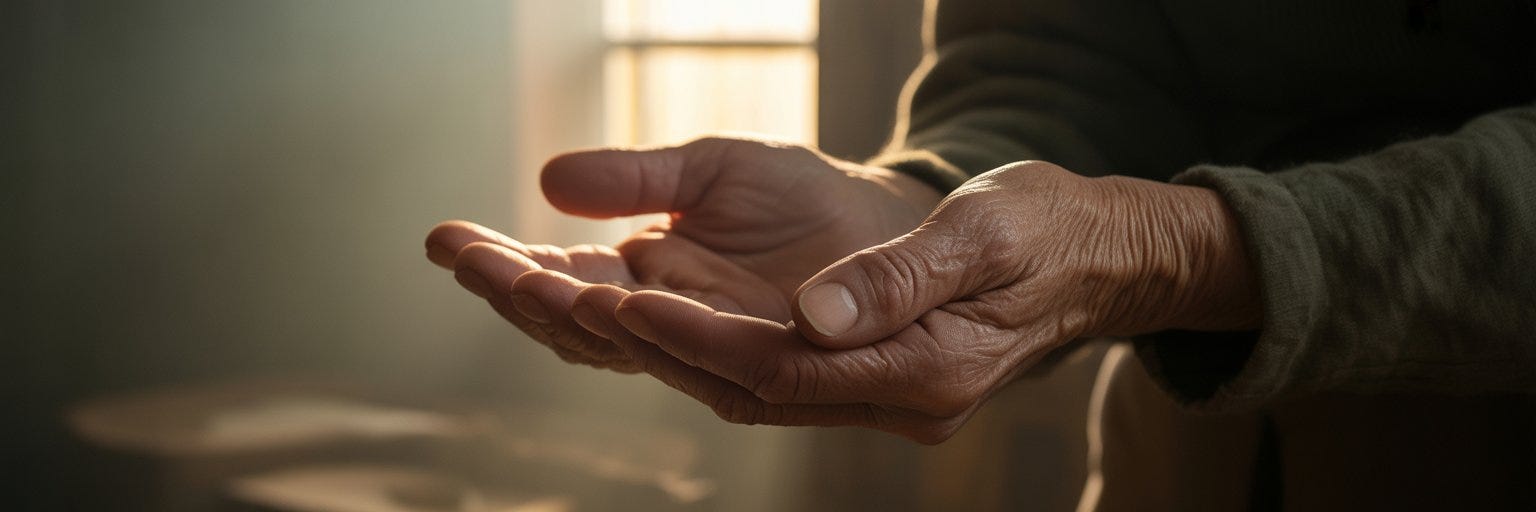
I wasn’t sure what this meant regarding her next treatment step. But I did know this. I was no longer alone. All I had to do was open my hands, and God, who created her and loved her, would step in and take care of her. I was no longer alone on this journey of my sister’s next steps.
I didn’t have to do anything. God didn’t say, “Give her to me.” That would take effort on my part. He said, “Let me have her.” All I had to do was open my hands and release her to Him. He would take her. My responsibility in this is to let Him. So simple. So easy.
Within twenty-four hours, the right doctors and healthcare professionals appeared. They guided me in my transition from life-giving support as a caregiver to comfort care as a caregiver. They showed me what was happening to my sister and her condition. I observed the changes in her physical and cognitive condition, but I didn’t know how to interpret them. These people showed me. Then they explained the next step. And it was the first time the next step made sense to me.
It was time we moved her to inpatient hospice care. Every morning, I struggled with this decision. Did I just take the easy way out for me? Was it really time for my sister to die?
Three days into hospice, my sister awakened for a moment as I held her hand.
She looked into my eyes and said, “I like it here. I love you.”
Then I knew. She was where she needed to be.
Those were her last words.
Two days later, she died.
Now God has her completely.
But what about me?
After three and a half years as a caregiver, I was no longer a caregiver. For three and a half years, my sister was my first priority in life.
Now what?