

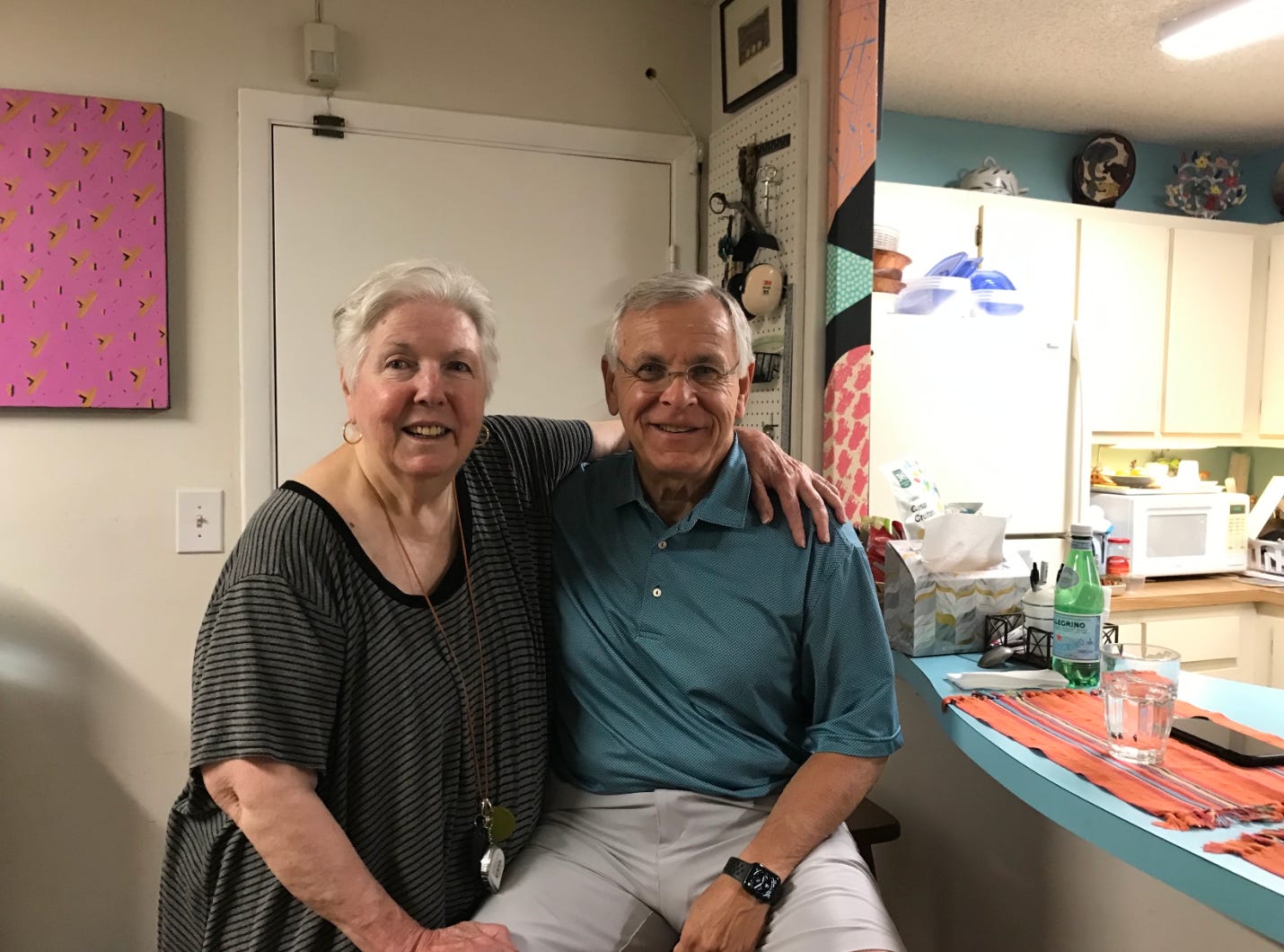
My sister was a feminist.
When Gloria Steinem was a Playboy Bunny at the NYC Playboy Club as research for an article series on women, my sister was a Senior at State Teachers College across the river in Jersey City. She was an English major, preparing to be a High School English teacher. But her real interests were in modern dance and painting classes. This was evidenced by her spending all her free time hanging out in Greenwich Village in NYC. This is where the free thinkers shared their counterculture philosophies. My sister, born in 1942, was primed for that thinking.
My father told my sister to go to secretarial school after high school. He expected her to be a secretary, meet a nice man, get married, and raise a family in Jersey City. Even as a Senior in High School, she knew she wanted so much more than that.
She wanted to be an artist, a creative.
She met people in NYC who talked to her differently because they saw her differently. These people, like her, saw the possibilities of changing the world through art and new ideas. She broke free of a society that was handcuffing her freedom of choice with its expectations.
My sister became a teacher after college. She lived at home and taught English at Roselle HS in New Jersey. Within a year, she befriended a physical education teacher. She was from Connecticut. She, too, had an alternative lifestyle idea. She, too, felt suffocated by her parents and community.
Within days of meeting, they found an apartment with a slanted floor and one window on a fire escape in West Greenwich Village. Just last week, this PE teacher, who is now 84, wrote to me and said, “I remember on Saturdays watching your sister sit in front of a blank canvas with a cigarette in one hand and a paintbrush in the other. She would be there painting all day.
They were living the life they chose, not the life their parents expected. They were living at ground zero of the feminist movement. They were there when this new movement was beginning to become a groundswell of change. Women in their twenties were looking for a leader. Gloria Steinem became that leader, their voice.
Being eleven years younger than my sister, I was influenced by her.
When I was choosing which High School to attend, she insisted I attend one in NYC. She wanted me to experience the mind-expanding rhythm and excitement of theworld’s biggest city. Cross the river. Get out of Jersey City and its parochial thinking. And my father caved, and I attended Xavier HS.
My sister left NYC for Miami just before my first day of school in NYC. This left me flying solo in an environment that was completely foreign to me as a fourteen-year-old. I joined young men from all over NYC and North Jersey who were stepping into something bigger. This was a college-preparatory school that taught us to think, to become leaders. The Jesuits were really good at this.
I visited my sister in Miami for two summers. It gave me the opportunity for good-paying work. It got me away from my parents and friends. It gave me a vision for what life might be like elsewhere. After I graduated, I attended the University of Miami. My life was changing. It was getting bigger by the day.
I commuted to the U. I couldn’t afford to live on campus. I slept on a couch for four years at my sister’s one-bedroom apartment. I figured out how to keep working a full-time hospitality job on Miami Beach while going to school from morning until night on Tuesdays and Thursdays. I had the economic need and the energy to pull this off and complete my degree.
Another story of my sister’s influence guiding me to a bigger life, a life beyond my parents’ expectations.
While working, I met a general manager who ran a multi-store retail TV rental business in West Germany. We connected. He liked me and saw promise. He asked if I would like to intern at his corporate office in Düsseldorf, Germany.
I consulted with my sister, and she said, “You have to do this.”
In one week, I secured my passport and was on a flight to Germany at twenty years old. When I landed in Düsseldorf in the summer of 19, I quickly realized no one spoke English. The frustration of not being able to understand people or express myself put me to the test.
My three years of German in high school were all I had to lean on. Within a month, and with the help of a few beers to give me confidence, I began speaking German. By the end of the summer, I was fluent. And it was there, at the corporate office, that I was exposed to accounting. When I returned for my Junior year, I switched to Accounting as my major. This experience was indispensable, life-changing, life-expanding.
This all led me to a Miami-based CPA firm, where I met Richard Brock, who was selling software to CPAs. He too saw promise in me. We became partners in his software company,y which was located in Mobile, Alabama. We were selling first-time automation to CPA firms nationwide. We moved the company to Atlanta to have access to the airport. Within four years, we sold the company. This radically changed my financial position and professional ambitions.
I was now running the software division of a publicly traded software company. I was traveling nationally and internationally. My world was huge.
To think all this happened because of my sister’s influence and encouragement. And she was influenced and sustained by the social movement called feminism, whose message was “You are free to choose who you want to be and what you want to do.” It was clearly directed at women at the time, but look at the influence one woman who embraced this movement had on me!
So, yes, Gloria Steinem changed my life.
And now at seventy-three, I see how all this wrkhow thisthis puzzle of success fits together.
All the people I knew who were successful left their childhood homes and communities and moved to another city or country.
Why is this?
We grow up with parents who have expectations for our lives. The community we are raised in embraces and promotes these expectations. Finally, society supports these expectations through government policies, businesses, and organizations.
An example is the secretarial schools that flourished in the 1950s and early 60s. Women who joined the workforce needed to learn to type, take shorthand, and serve men in business. These expectations created systems to support them.
The only way to break free of these expectations is to leave the communities practicing them.
This is what I observed in my lifetime. This is the common thread I see among the successful people I know. Leaving the community you grew up in is not the only path to success. But I do think it is much easier to break free of parental and community expectations if you are no longer part of that community. This takes a lot of vision, commitment, and courage. Moving to a new city is far easier!
Great one Charlie. I love that you are reflecting back and acknowledging those who bent the arch of your life and in this case your sister and Richard Brock. We all have those formative figures and don’t always recognize them. I’m inspired by your writing.